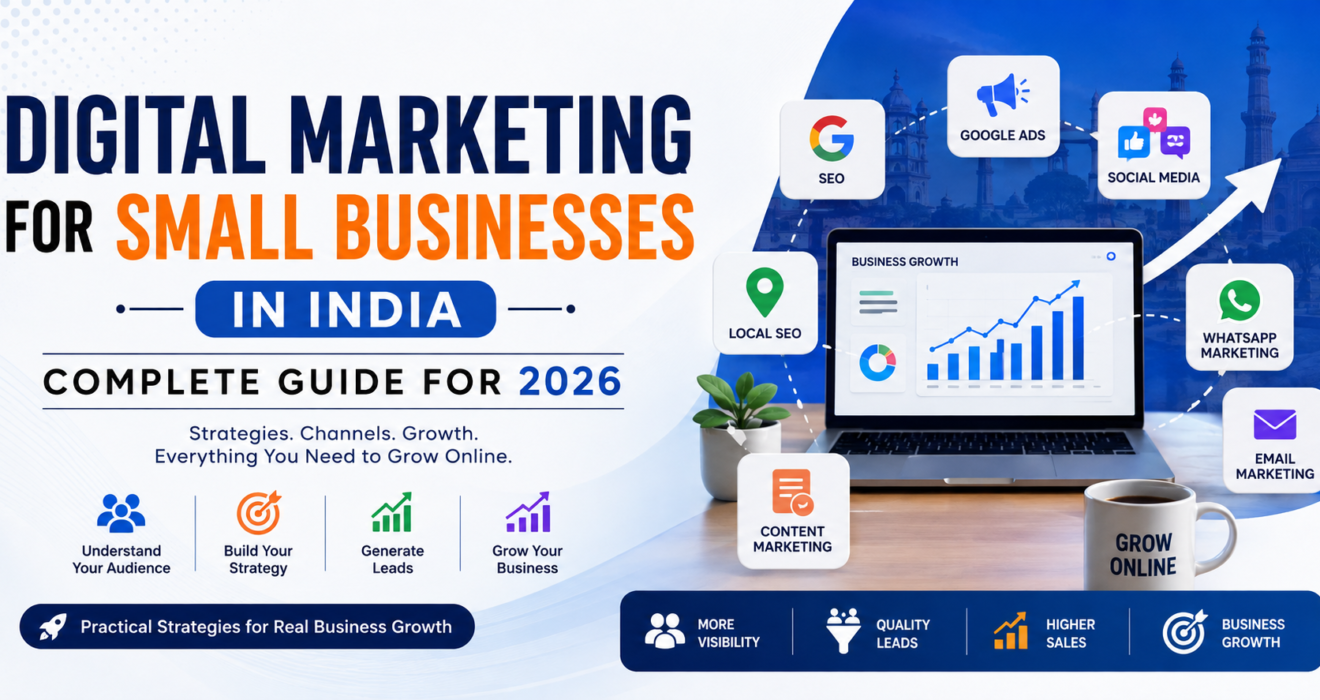
Digital Marketing for Small Businesses in India: Complete Guide for 2026
Digital Marketing for Small Businesses in India: Complete Guide for 2026
Last Updated: August 2026
For a small business in India, having a website or social media page is no longer enough. Customers search on Google, compare businesses on social platforms, watch videos, read reviews, ask questions in WhatsApp, and increasingly use AI-powered search experiences to discover information.
A practical digital marketing strategy brings these channels together to attract the right audience, generate qualified leads, build trust, and convert online visitors into customers.
In this guide, we explain digital marketing for small businesses in India, including SEO, local SEO, Google Ads, social media marketing, content marketing, WhatsApp, website optimization, AI-powered search and how to create a realistic strategy for 2026.
Quick Answer: What Is the Best Digital Marketing Strategy for a Small Business in India?
The best digital marketing strategy depends on your industry, location, customers, competition and budget. For many Indian small businesses, a strong foundation includes a conversion-focused website, Google Business Profile and local SEO, useful SEO content, social media, review management and a measurable paid advertising strategy. Businesses should then add WhatsApp, email marketing, automation and AI-search optimization where these channels support customer acquisition and retention.
Google’s current guidance for AI Overviews and AI Mode continues to emphasize the same core SEO principles: create useful, original content, make pages accessible to search engines, provide a good page experience and focus on satisfying the user’s information need.
What Is Digital Marketing for Small Businesses?
Digital marketing is the use of online channels and technologies to attract potential customers, communicate with them, generate leads, sell products or services, and build long-term relationships.
For a small business, digital marketing can include:
- Search engine optimization (SEO)
- Local SEO and Google Business Profile
- Google Ads and PPC
- Social media marketing
- Content marketing
- Website and landing-page optimization
- Email marketing
- WhatsApp marketing
- Video and YouTube marketing
- Online reputation management
- Ecommerce marketing
- Conversion rate optimization
- Marketing automation
- AI-assisted search and content optimization
The important point is that digital marketing is not simply posting on Instagram or running advertisements. It is a complete customer-acquisition system.
A potential customer may discover your business through Google, check your website, see your Instagram profile, read reviews, contact you through WhatsApp and finally become a customer after speaking with your sales team.
Your strategy should therefore connect these touchpoints rather than treating them as separate activities.
Why Digital Marketing Matters for Small Businesses in India
Indian consumers increasingly use digital channels before making purchasing decisions. Even when the final transaction happens offline, customers may research a business online first.
For example, someone looking for a local service may:
Search Google → check Maps → visit website → read reviews → compare competitors → contact on WhatsApp → purchase
A different customer may follow:
Instagram Reel → profile visit → website → enquiry form → sales call → purchase
This means your digital presence should answer five basic questions:
- Can people find your business?
- Can they understand what you offer?
- Can they trust your business?
- Can they contact you easily?
- Can you measure what happens after they contact you?
A good digital marketing strategy is built around these questions.
The 10 Most Important Digital Marketing Channels for Small Businesses
1. Search Engine Optimization (SEO)
SEO helps your website appear when potential customers search for products, services, information or businesses related to what you offer.
For a small business, SEO can target:
- Product keywords
- Service keywords
- Local searches
- Problem-based searches
- Informational searches
- Comparison searches
- Long-tail keywords
- Industry-specific searches
For example, a Delhi NCR business might target queries such as:
- digital marketing company in Noida
- SEO company in Noida
- website development company in Noida
- best digital marketing agency for small business
- SEO services for local businesses
SEO is particularly useful for businesses that want to build a long-term source of relevant organic traffic.
IT WebTech Solutions currently positions its SEO services around on-page SEO, technical SEO, keyword strategy, content SEO, local SEO and newer AI-search-related optimization services.
Why SEO is important
SEO can help a small business:
- Generate targeted organic traffic
- Build long-term search visibility
- Capture customers with high purchase intent
- Establish topical authority
- Reduce dependence on paid traffic
- Support brand credibility
SEO is not an instant-results channel. The time required varies based on competition, website quality, authority, content and implementation. Your strategy should therefore measure progress through traffic, qualified leads, conversions and revenue rather than rankings alone.
2. Local SEO
For businesses serving a particular city, area or service region, local SEO can be one of the highest-value digital marketing activities.
Local SEO helps businesses become more visible for location-based searches such as:
- digital marketing company near me
- dentist in Noida
- interior designer in Delhi
- photographer in Gurgaon
- travel agency in Delhi
- best restaurant in Sector 63 Noida
Important local SEO activities include:
Google Business Profile
Maintain an accurate and complete profile with:
- Correct business name
- Address
- Phone number
- Website
- Business categories
- Opening hours
- Services
- Photos
- Reviews
- Posts and updates
Local landing pages
Create useful location-specific pages when you genuinely serve those locations.
For example:
Digital Marketing Services in Noida
can be more useful than creating dozens of near-identical city pages that provide little unique information.
Customer reviews
Encourage genuine customers to leave honest reviews and respond professionally to feedback.
Local business information
Keep your name, address and contact information consistent across important online profiles.
3. Google Ads and PPC
SEO is valuable for long-term growth, but some businesses need leads immediately.
This is where Google Ads and PPC can help.
Paid search can place your business in front of people who are actively looking for a product or service.
For example:
“SEO company in Noida”
has stronger commercial intent than a broad search such as:
“what is SEO?”
A good PPC campaign should not focus only on getting clicks.
It should optimize the complete journey:
Keyword → Ad → Landing Page → Lead → Qualified Lead → Customer → Revenue
The campaign should therefore track meaningful conversions such as:
- Phone calls
- WhatsApp enquiries
- Contact forms
- Demo requests
- Purchases
- Bookings
- Qualified leads
IT WebTech’s current digital-marketing service offering includes PPC, CRO and performance-oriented marketing alongside SEO and social media.
4. Social Media Marketing
Social media can help small businesses build awareness, credibility and engagement.
The right platform depends on the audience.
Useful for:
- Visual brands
- Travel
- Fashion
- Food
- Photography
- Beauty
- Lifestyle
- Local businesses
Useful for:
- Local audiences
- Communities
- Retargeting
- Offers
- Service businesses
Useful for:
- B2B companies
- Consultants
- IT services
- SaaS
- Professional services
- Recruitment
YouTube
Useful for:
- Tutorials
- Product demonstrations
- Reviews
- Educational content
- Expertise-based marketing
A common mistake is trying to be active on every platform.
A small business with limited resources will often perform better by choosing two or three channels where its target audience is genuinely active.
5. Content Marketing
Content marketing means creating useful information that helps your target customer make a decision.
Examples include:
- Blog posts
- Guides
- Case studies
- Tutorials
- Comparison pages
- FAQs
- Videos
- Checklists
- Original research
- Industry insights
Instead of asking:
“What keyword should we write about?”
ask:
“What problem does our ideal customer need help solving?”
For example, a web development company could create:
How Much Does a Business Website Cost in India in 2026?
Instead of writing another generic article about:
What Is Web Development?
The first topic addresses a real buying question.
This people-first approach aligns with Google’s current guidance, which encourages original, useful content created to satisfy users rather than content produced primarily to attract search traffic.
6. WhatsApp Marketing
WhatsApp is particularly useful for businesses that rely on direct conversations before purchase.
It can support:
- Lead enquiries
- Customer support
- Appointment booking
- Product enquiries
- Follow-ups
- Order updates
- Offers
- Lead nurturing
- Automated responses
For example:
Google Search → Website → WhatsApp → Sales conversation → Customer
The objective should not be to send large numbers of promotional messages.
Instead, use WhatsApp to make communication easier and more relevant.
7. Email Marketing
Email marketing remains useful for businesses that have repeat customers, subscribers or qualified leads.
You can use email for:
- Welcome sequences
- Lead nurturing
- Offers
- Product updates
- Educational content
- Customer retention
- Re-engagement
- Event invitations
For B2B businesses, email can be particularly useful because sales cycles are often longer and require multiple interactions before a decision.
8. Conversion Rate Optimization
Getting traffic is only half the job.
Suppose your website receives 10,000 visitors but only generates 20 enquiries.
The problem may not be traffic.
It could be:
- Weak messaging
- Poor landing pages
- Confusing navigation
- Slow website
- Weak trust signals
- Difficult contact forms
- No clear call to action
- Poor mobile experience
Conversion rate optimization focuses on making the existing traffic more likely to take the desired action.
A simple improvement can sometimes create more business than increasing traffic alone.
9. Online Reputation Management
Before contacting a business, people often look at reviews, social profiles and online mentions.
Your reputation therefore affects conversion.
Build trust through:
- Genuine customer reviews
- Testimonials
- Case studies
- Portfolio pages
- Business information
- Founder/team information
- Transparent service descriptions
- Accurate claims
Avoid fake reviews or exaggerated results.
Trust is central to Google’s E-E-A-T concept, and Google states that trust is the most important part of E-E-A-T among these qualities.
10. AI Search and AI SEO
Search behavior is changing.
Users can now ask longer questions and expect summarized answers from AI-powered search experiences.
Google’s current documentation says its generative AI search features are grounded in its core Search systems, which means traditional SEO fundamentals remain relevant.
For businesses, this creates an important shift:
Instead of optimizing only for:
“Can I rank #1?”
you should also ask:
“Does my content provide enough trustworthy information to be used as a source when someone asks a detailed question?”
That means your content should:
- Answer questions directly
- Explain concepts clearly
- Demonstrate experience
- Include useful examples
- Use descriptive headings
- Support claims with credible information
- Keep important information visible in HTML text
- Strengthen topical relationships between pages
- Provide original insights
Google’s official guidance for AI search specifically recommends unique, valuable content, good page experience and ensuring that Google can crawl and index your content.
SEO vs Google Ads: Which Is Better for a Small Business?
There is no universal winner.
The right choice depends on your business model and goals.
| Goal | SEO | Google Ads |
|---|---|---|
| Immediate traffic | Lower | Higher |
| Long-term visibility | Strong | Dependent on spend |
| Pay for every click | No | Yes |
| Build organic authority | Strong | Limited |
| Test offers quickly | Moderate | Strong |
| Local lead generation | Strong | Strong |
| Long-term compounding value | Strong | Limited |
| Budget control | Gradual | High |
For many businesses, the strongest strategy is not SEO or PPC.
It is:
SEO + PPC + conversion optimization
Paid campaigns can capture immediate demand while SEO builds a longer-term organic acquisition channel.
How Much Does Digital Marketing Cost for a Small Business in India in 2026?
There is no single price that fits every business.
The cost depends on:
- Industry
- Competition
- City or geographic target
- Website condition
- Number of services
- Content requirements
- SEO difficulty
- Advertising budget
- Social media requirements
- Lead volume
- Reporting and technology requirements
A business should separate service fees from media spend.
For example:
Agency/marketing fee + Google/Meta advertising budget + content/creative costs + technology/tool costs
This makes budgeting much easier.
A practical approach
A small local business could begin with:
Website + Google Business Profile + Local SEO + selected social content
A growing service business may add:
SEO + content + Google Ads + landing pages + WhatsApp
A competitive company may require:
Technical SEO + content + digital PR/link building + paid acquisition + CRO + remarketing + automation + analytics
The right question is not:
“What is the cheapest digital marketing package?”
The better question is:
“What level of investment is appropriate for the value of a customer and the competitiveness of my market?”
How to Create a Digital Marketing Strategy for Your Small Business
Step 1: Define Your Ideal Customer
Write down:
- Who buys from you?
- What problem do they have?
- Where are they located?
- What is their approximate buying power?
- What questions do they ask?
- Why do they choose one company over another?
Without this, your marketing will become generic.
Step 2: Define Your Business Goal
Choose measurable objectives.
Examples:
- 50 qualified leads per month
- 20 ecommerce orders per week
- 30 demo bookings
- Increase organic leads by 40%
- Increase local enquiries
- Improve conversion rate
Avoid making “increase followers” your primary business objective unless brand awareness itself is the goal.
Step 3: Audit Your Current Digital Presence
Review:
- Website
- Google Business Profile
- Search rankings
- Organic traffic
- Social media
- Reviews
- Competitors
- Landing pages
- Conversion tracking
- Paid campaigns
Identify the biggest gap before spending more money.
Step 4: Choose Your Primary Channel
Use your business model to decide.
Local service business
Start with:
Local SEO + Google Business Profile + reviews + website
B2B company
Start with:
SEO + LinkedIn + content + lead generation
Ecommerce business
Start with:
Ecommerce SEO + paid ads + product content + remarketing
New startup
Start with:
Website + positioning + content + SEO + selective paid acquisition
Highly competitive business
Use:
SEO + PPC + content + CRO + reputation + remarketing
Step 5: Build a Content Strategy
Create content around the customer’s journey.
Awareness
“What is digital marketing?”
Consideration
“SEO vs Google Ads: Which is better?”
Decision
“How much does SEO cost in India?”
Trust
“How our SEO process works”
Proof
“SEO case study for a local business”
This approach is more commercially useful than publishing random blog posts.
How to Make Your Website Ready for Google AI Overviews
There is no guaranteed formula for appearing in an AI Overview.
Google’s guidance says there are no separate technical requirements or special optimizations that guarantee inclusion; the core SEO and content foundations still matter.
A strong AI-search-ready website should therefore:
1. Answer the main question quickly
Give readers a useful answer near the beginning.
2. Use clear headings
Break complex subjects into logical sections.
3. Explain concepts in plain language
Avoid unnecessary jargon.
4. Add original experience
Share observations, examples, processes and lessons learned from real work.
5. Build topical depth
Create interconnected pages that cover a subject from different search intents.
6. Strengthen trust
Include:
- About information
- Author information
- Contact details
- Reviews
- Case studies
- Business details
- Relevant credentials and experience
7. Keep the website technically accessible
Important pages should be crawlable and indexable.
8. Improve page experience
Make pages easy to read and navigate on mobile and desktop.
9. Use helpful visual content
Screenshots, diagrams, examples and relevant images can make complex subjects easier to understand. Google’s AI-search guidance also recommends supporting text with high-quality images and videos where useful.
10. Measure outcomes
Don’t measure only impressions and rankings.
Track:
Traffic → Engagement → Leads → Sales → Revenue
Google announced dedicated Search Console reporting for visibility from generative AI features such as AI Overviews and AI Mode, with the rollout initially available to a subset of sites.
Common Digital Marketing Mistakes Small Businesses Make
Trying Every Platform
You don’t need to be everywhere.
Choose the channels where your customers actually spend time.
Buying Cheap SEO
Very low-cost SEO often focuses on activity rather than outcomes.
Ask what work will actually be performed.
Publishing Without a Strategy
A business can publish 50 articles and still receive little useful traffic if the content doesn’t match search intent.
Ignoring Conversion
More visitors don’t automatically mean more customers.
Focusing Only on Followers
Followers can help, but revenue, leads and qualified enquiries matter more.
Using AI to Produce Mass Content
AI can help with research, structure and productivity, but publishing large volumes of low-value pages without meaningful human input can create quality and spam-policy risks. Google specifically warns against scaled content that adds little value.
Ignoring Customer Reviews
Reviews influence trust and local discovery.
Not Measuring Leads
Traffic without conversion tracking creates incomplete reporting.
A Simple 90-Day Digital Marketing Plan for Small Businesses
Days 1–30: Build the Foundation
Focus on:
- Website audit
- Analytics and conversion tracking
- Google Business Profile
- Keyword research
- Competitor research
- Technical SEO
- Core service pages
- Social profile optimization
- Review strategy
Days 31–60: Start Acquisition
Launch:
- SEO content
- Local SEO activities
- Social content
- Google Ads where appropriate
- Landing-page improvements
- WhatsApp lead flow
- Lead follow-up process
Days 61–90: Optimize
Analyze:
- Best-performing keywords
- Organic traffic
- Qualified leads
- Cost per lead
- Conversion rate
- Ad performance
- Landing-page performance
- Content engagement
Then invest more in the channels producing business results.
How to Choose a Digital Marketing Agency in India
Before hiring an agency, ask:
Do they understand your industry?
A generic strategy may not work for a specialized market.
Can they explain the strategy?
You should understand what they are doing and why.
Do they focus on business outcomes?
Ask about:
- Leads
- Sales
- Revenue
- Conversion rate
- Cost per acquisition
Can they show real work?
Look for:
- Case studies
- Portfolio
- Client examples
- Testimonials
- Process documentation
Are they transparent?
You should know:
- What services are included
- What is excluded
- Reporting frequency
- Ad spend
- Contract terms
- Responsibilities
A reliable agency should help you understand the process instead of making unrealistic ranking guarantees.
Why IT WebTech Solutions Can Be a Useful Partner for Small Businesses
IT WebTech Solutions provides a broader digital-growth offering rather than limiting its services to a single channel. Its current service structure includes digital marketing, SEO, PPC, social media marketing, conversion optimization, content marketing, WhatsApp and email marketing, ecommerce marketing and related services.
Its SEO service page also combines traditional SEO capabilities such as technical SEO, on-page SEO, content SEO and local SEO with AI-search-oriented areas such as AIO, GIO, GEO, semantic/entity SEO and AEO.
The company states that it has 15+ years of industry experience, 500+ projects delivered, 300+ successful campaigns and 200+ customers. These claims should be supported on-page with appropriate evidence, case studies or client references wherever possible.
For a business evaluating an agency, the most important consideration should still be the fit between the agency’s capabilities, your goals, market and available budget.
Frequently Asked Questions
What is the best digital marketing strategy for a small business in India?
For many small businesses, a strong website, local SEO, Google Business Profile, useful content, social media and selective paid advertising provide a solid foundation. The ideal mix depends on your market, location, customers and business model.
How much does digital marketing cost for a small business in India?
There is no fixed price. Cost varies by industry, competition, services, advertising budget, content requirements and goals. Businesses should evaluate marketing investment against customer value and expected return rather than choosing solely on the lowest package price.
Is SEO worth it for a small business?
Yes, especially when customers actively search for the products or services you offer. SEO can build long-term visibility and attract relevant organic traffic, but it requires consistent work and realistic expectations.
Is Google Ads better than SEO?
Neither is universally better. Google Ads can produce faster visibility, while SEO can create long-term organic traffic. Many businesses benefit from using both.
How long does SEO take to show results?
There is no universal timeline. Results depend on competition, website quality, content, technical SEO, authority and implementation. Businesses should monitor trends in visibility, traffic, leads and conversions rather than expecting a fixed result after a specific number of days.
How can a small business appear in Google AI Overviews?
There is no guaranteed shortcut. Google says its AI search experiences rely on its existing Search systems and recommends strong SEO fundamentals, useful and original content, technical accessibility and a good page experience.
What is AI SEO?
AI SEO generally refers to using modern AI tools and search concepts to improve content research, optimization and visibility across evolving search experiences. It should complement, not replace, sound SEO fundamentals.
What is the difference between SEO, AEO and GEO?
SEO focuses broadly on visibility in search engines. AEO is commonly used for optimizing content to answer questions directly in answer-based experiences. GEO is commonly used to describe optimization for generative or AI-driven search systems. These terms overlap, and businesses should focus on the underlying principles—useful content, strong entities, clear answers, authority, accessibility and trust—rather than treating the terminology as a ranking shortcut.
Should a small business hire an agency or do digital marketing in-house?
It depends on internal skills, budget, complexity and available time. An agency can be useful when the business needs specialized SEO, paid advertising, content, web development or analytics capabilities that are difficult to maintain internally.
Final Thoughts
Digital marketing for small businesses in India is no longer about choosing one platform and posting regularly.
The stronger approach is to build a connected system:
Website → SEO → Local Search → Content → Social Media → Paid Ads → WhatsApp → Conversion → Retention
The goal is not to generate traffic for its own sake.
The goal is to create a digital presence that helps the right customer discover your business, understand your value, trust you and take action.
In 2026, that principle becomes even more important as search increasingly includes AI-powered experiences. Google’s guidance is clear that AI search does not replace SEO fundamentals. Websites still need useful, original, trustworthy content that can be crawled, understood and connected to users’ needs.
For small businesses, the winning strategy is therefore not to chase every new marketing trend.
It is to build a strong foundation, measure what produces business results, and improve that system consistently.
Ready to build a digital marketing strategy for your business? Explore IT WebTech Solutions’ Digital Marketing Services and SEO Services.