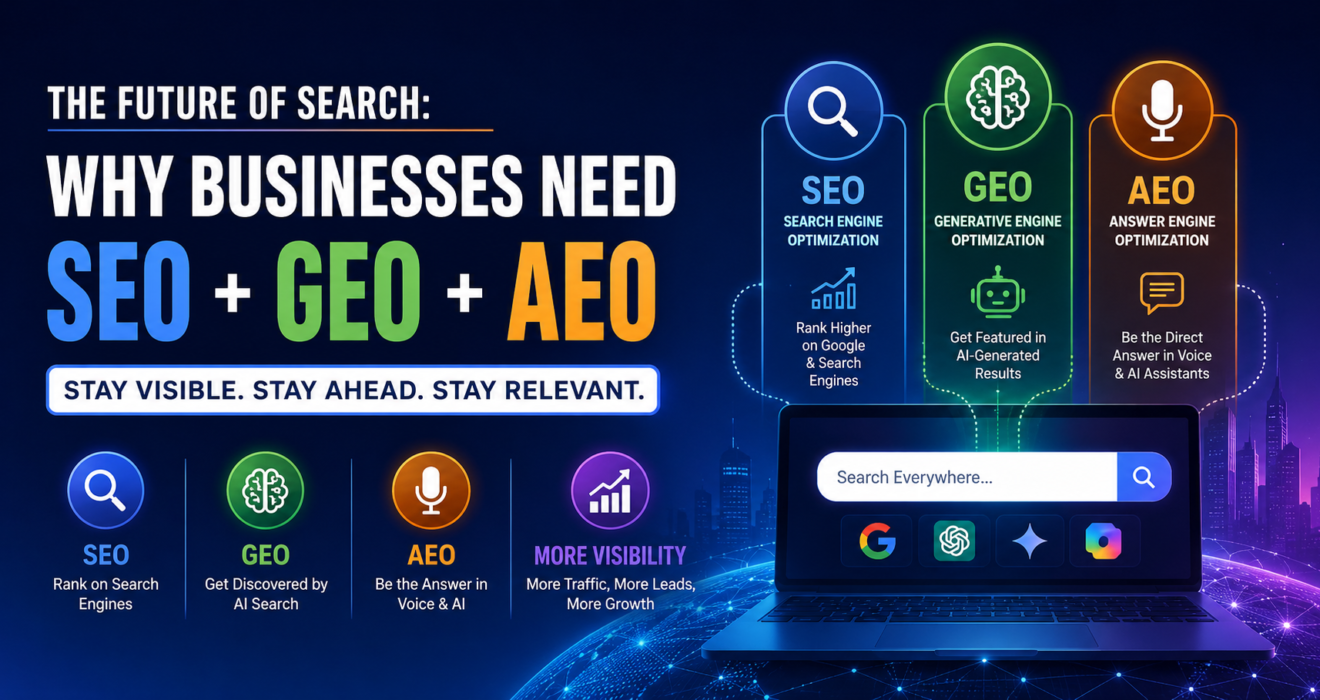
The Future of Search: Why Businesses Need SEO + GEO + AEO in 2026
Table of Contents
ToggleSEO, GEO, AEO: The New Rules of Online Visibility
A few years ago, ranking on Google felt pretty straightforward. Add keywords, publish blogs, get backlinks, and hope your website climbs the rankings.
But search has changed. Fast.
Today, your customers are not just typing queries into Google anymore. They’re asking ChatGPT, using voice assistants, checking AI summaries, browsing YouTube, searching on Instagram, and even getting recommendations directly from AI tools.
That’s why businesses now need more than traditional SEO.
They need:
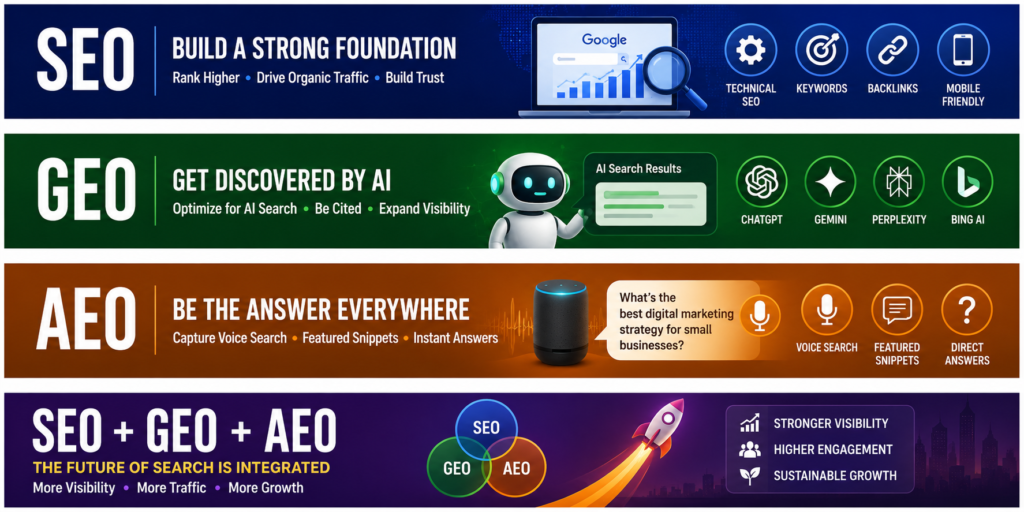
- SEO (Search Engine Optimization)
- GEO (Generative Engine Optimization)
- AEO (Answer Engine Optimization)
Together, these form what many marketers now call AI search optimization or Search Everywhere Optimization.
And honestly? Small businesses in India cannot afford to ignore this shift.
Why Search Is Changing So Quickly
Think about how people search today.
Instead of typing:
“best digital marketing agency Delhi”
People now ask:
“Which marketing agency is good for small businesses near me?”
Or they ask ChatGPT:
“Suggest affordable SEO agencies for local businesses in India.”
Search is becoming conversational. AI-driven. Personalized.
Google itself is moving toward AI-generated answers. Voice search usage keeps growing. And platforms like ChatGPT, Gemini, Perplexity, and Bing AI are influencing buying decisions.
If your business only focuses on old-school SEO, you’re probably missing visibility in places where customers are already searching.
What Is Traditional SEO?
Traditional SEO Still Matters (A Lot)
Before we talk about AI, let’s clear one thing up:
traditional SEO is NOT dead.
It’s still the foundation.
Without proper SEO:
- Your website won’t rank
- AI tools may not trust your content
- Search engines may ignore your pages entirely
Traditional SEO focuses on:
- Keyword optimization
- Technical website health
- Backlinks
- Page speed
- Mobile friendliness
- User experience
But modern SEO has evolved into something smarter called semantic SEO.
Semantic SEO: Understanding Search Intent
Earlier, marketers stuffed exact keywords everywhere.
Now search engines understand context.
For example:
A page optimized for:
“best running shoes”
might also rank for:
- shoes for marathon training
- lightweight running sneakers
- comfortable jogging shoes
That’s semantic SEO.
Search engines now look at:
- meaning
- relevance
- topical authority
- user intent
Practical Tip for Small Businesses
Instead of writing:
“Best bakery in Noida” twenty times…
Create genuinely useful content like:
- “How to Choose a Birthday Cake for Kids”
- “Eggless Cake Trends in India”
- “Custom Cakes Delivery Guide”
This builds authority naturally.
What Is GEO (Generative Engine Optimization)?
Generative Engine Optimization Explained
Generative Engine Optimization (GEO) is the process of optimizing your content for AI search systems.
These include:
- ChatGPT
- Google AI Overviews
- Gemini
- Perplexity AI
- Bing Copilot
Unlike traditional search, AI search often gives users direct answers instead of just links.
That changes everything.
If your business content is clear, trustworthy, and structured properly, AI tools may quote or reference your business in answers.
That’s massive visibility.
How AI Search Works Differently
Traditional search:
- Shows 10 blue links
AI search:
- Summarizes information
- Pulls answers from multiple sources
- Prioritizes authority and clarity
So your content must be:
- conversational
- factually accurate
- easy to scan
- well-structured
- deeply helpful
Real-World Example of GEO
Let’s say you run a skincare clinic in Mumbai.
Old SEO strategy:
- Target “best skin clinic Mumbai”
GEO strategy:
Create content like:
- “What causes pigmentation in Indian skin?”
- “Laser vs chemical peel: which is safer?”
- “How much does acne treatment cost in Mumbai?”
When AI tools answer these questions, your content has a better chance of being cited.
That’s the power of AI search visibility.
GEO Tips for Indian Small Businesses
1. Write Like Humans Talk
AI systems prefer natural language.
Avoid robotic writing.
2. Answer Specific Questions
Use FAQ sections, short explanations, and practical examples.
3. Build Trust Signals
Include:
- reviews
- author expertise
- case studies
- local examples
4. Focus on Topic Depth
One high-quality guide is often better than ten thin blogs.
What Is AEO (Answer Engine Optimization)?
Answer Engine Optimization Is Growing Fast
Answer Engine Optimization (AEO) helps your content appear as direct answers in:
- voice search
- featured snippets
- AI assistants
- smart devices
Think about how people use voice search now.
They ask:
- “Which dentist near me is open today?”
- “What’s the best budget phone under 20,000?”
- “How do I improve local SEO?”
Google, Alexa, Siri, and AI assistants try to provide immediate answers.
Your content should be optimized for that.
Why Voice Search Matters in India
India has millions of mobile-first internet users.
Many users:
- search using voice
- mix Hindi and English
- use conversational phrases
That means businesses should create content that sounds natural.
Not overly polished. Not robotic.
How to Optimize for AEO
Use Question-Based Headings
Example:
- “How Much Does SEO Cost in India?”
- “What Is Local SEO?”
Give Direct Answers First
Answer the question immediately.
Then explain in detail.
Use Structured Formatting
Include:
- bullet points
- tables
- FAQs
- short paragraphs
Improve Local Search Signals
For local businesses:
- optimize Google Business Profile
- collect reviews
- maintain consistent contact details
Why Businesses Need SEO + GEO + AEO Together
Here’s the reality:
Relying only on traditional SEO today is like opening a shop but refusing to list it on Google Maps.
Customers search everywhere now.
Your visibility strategy must also work everywhere.
| Strategy | Purpose |
|---|---|
| SEO | Rank on search engines |
| GEO | Get cited by AI tools |
| AEO | Become the direct answer |
Together, they create a complete digital visibility system.
Common Mistakes Business Owners Are Making
1. Writing Only for Google
Many websites still create robotic keyword-heavy content.
That approach is fading quickly.
2. Ignoring AI Search Optimization
Businesses assume AI search is “future stuff.”
It’s already happening.
3. Publishing Thin Content
Short, generic blogs rarely perform well now.
Depth matters.
4. No Local Optimization
Many Indian small businesses still ignore:
- Google Business Profile
- local SEO
- customer reviews
That’s a huge missed opportunity.
A Simple AI SEO Strategy for 2026
You don’t need a massive budget to adapt.
Start with this:
Step 1: Fix Your SEO Foundation
- mobile speed
- technical SEO
- metadata
- internal linking
Step 2: Create Helpful Content
Focus on:
- customer problems
- real questions
- local intent
Step 3: Optimize for AI Search
Write conversationally.
Use clear structure.
Step 4: Add FAQ Sections
AI tools love concise answers.
Step 5: Build Authority
Publish:
- case studies
- original insights
- expert opinions
Case Study-Style Example
One local furniture brand in Bengaluru struggled to generate online leads despite spending on ads.
Their website had product pages but almost no educational content.
After shifting strategy:
- added SEO blogs
- created voice-search-friendly FAQs
- optimized content for AI search
- improved local SEO
Within months:
- organic traffic improved
- AI-generated search mentions increased
- inbound leads became more consistent
The biggest difference?
Their content finally answered real customer questions instead of just trying to rank keywords.
Why Hiring Experts Can Save Time
Many business owners try doing everything themselves:
- SEO
- ads
- social media
- website updates
Eventually, it becomes overwhelming.
An experienced digital marketing agency can help by:
- building long-term SEO systems
- optimizing for AI search
- improving local visibility
- tracking what actually converts
More importantly, experts help avoid costly mistakes that waste months of effort.
The Future of Search Is Already Here
The future of search is not just Google rankings anymore.
It’s:
- AI recommendations
- voice assistants
- conversational search
- direct answers
- multi-platform visibility
Businesses that adapt early will have a major advantage.
Those who don’t may slowly disappear from where customers are searching.
The smartest move now is building an integrated AI SEO strategy that combines:
- SEO
- GEO
- AEO
Not separately. Together.
FAQs
1. What is the difference between SEO, GEO, and AEO?
SEO focuses on search engine rankings, GEO helps content appear in AI-generated responses, and AEO optimizes content for direct answers and voice search.
2. Is traditional SEO still important in 2026?
Yes. traditional SEO remains the foundation for visibility, trust, and indexing across search engines and AI systems.
3. What is AI search optimization?
AI search optimization means creating content that performs well in AI-powered search systems like ChatGPT, Gemini, and Google AI Overviews.
4. Why is voice search important for Indian businesses?
Voice search is growing rapidly in India due to mobile-first users and multilingual search habits.
5. How can small businesses start with GEO and AEO?
Start by:
- answering customer questions
- writing naturally
- using FAQ sections
- improving local SEO
- publishing expert content regularly
Final Thoughts
Search behavior is evolving faster than most businesses realize.
People don’t just “Google” anymore. They ask AI tools, speak into phones, and expect instant answers.
That’s why businesses need a broader visibility strategy built around SEO + GEO + AEO.
If you want your business to stay discoverable in the next few years, now is the time to adapt.
Contact us today for a free consultation.